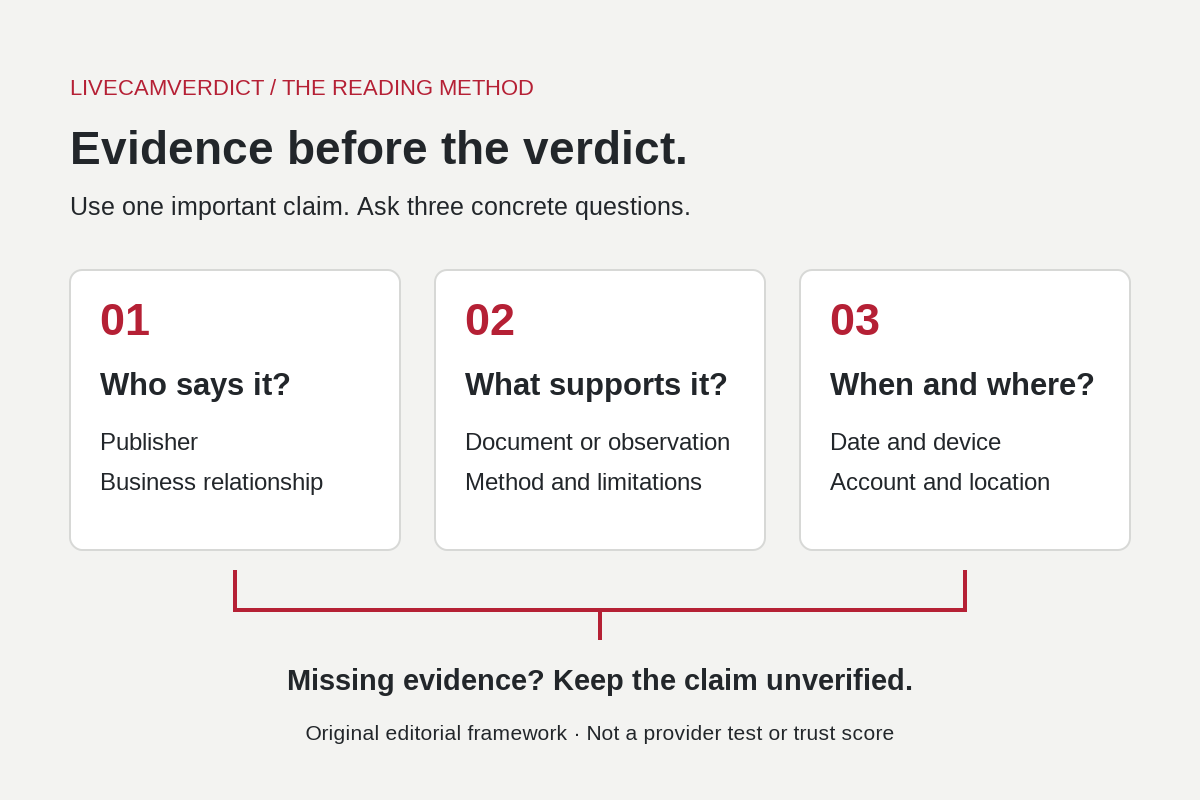
Choose one claim that matters to you. Find its evidence, its date and its limits. If the review cannot supply those, keep that claim unverified rather than filling the gap with a star rating.
Why do this before the offers arrive?
November is a useful moment to decide how you will compare services before seasonal promotions compete for your attention. This article is a practical preparation exercise, not evidence that cam-site discounts or review fraud have increased. We have not measured either trend, and no offer is being endorsed here.
The reader question is narrower: when a page calls a service private, reliable or best, what should you ask it to prove? Begin with one decision that would change your behaviour. For example, you might need readable mobile controls, a clear cancellation route or an explanation of camera sharing. A long list of features is less useful than a supported answer to that one question.
1. Separate a test from a document summary
A provider help page can establish what the provider currently says. It cannot establish that an independent editor completed a purchase, tested a refund or observed a particular connection. Likewise, an attractive illustration can explain a concept without documenting a real session. Look for a sentence that identifies the kind of work behind the conclusion.
Google’s review guidance encourages evidence of first-hand experience, original research and reasons behind recommendations. Use that as a reading prompt, not as a guarantee attached to a search result. A well-positioned page can still leave your specific question unanswered.
Try this small annotation exercise: mark each important statement as provider documentation, observed behaviour or editorial judgment. If the author says a process is easy, ask whether the page describes the process or reports trying it. Both can be useful when their scope is clear.
Reference: Google Search Central: Write high quality reviews (opens in a new tab)
2. Ask when, where and under which conditions
A useful observation has boundaries. A reviewer may have checked one browser, one country, one account state and one date. Those conditions matter when a feature depends on device support or access rules. A desktop screenshot does not settle whether a mobile control remains readable; a public help page does not settle what a signed-in account can do.
Look for a real assessment date, not only a prominent updated label. Then check whether the evidence addresses the same version of the feature you are considering. If the article changed a date without describing a substantive change, you still need the underlying reference.
Write a short note in your own words: “This source supports this feature in these circumstances; this other point remains unknown.” That note prevents a narrow observation growing into a universal promise when you return to the comparison later.
3. Read the business relationship without guessing the result
A referral relationship is relevant context. Find the disclosure before relying on a recommendation, then check whether the editorial reasoning survives without the referral button. An affiliate link does not itself prove the article is wrong, and a disclosure does not establish that its claims were tested.
The FTC’s consumer-review guidance distinguishes consumer evaluations, promotional testimonials and company-controlled sites that claim independence. These are US regulatory materials with specific scope, not a global certificate for review websites. For this reading exercise, the useful question is simply who is speaking and what relationship should you understand.
Apply the same discipline to ratings. Ask who supplied a score, what it measures and how many observations it represents. A provider feed rating and an editorial assessment answer different questions. If a page supplies no method, avoid interpreting the number as a measured probability that you will have a good experience.
Reference: FTC: Consumer Reviews and Testimonials Rule questions and answers (opens in a new tab)
4. Run a ten-minute evidence pass
You do not need to audit every sentence. Spend your attention on the claim that could cause you to register, share information or pay. The following is an editorial workflow, not a numerical trust score. A missing detail is a reason to pause that decision, not proof of wrongdoing.
| Question | Useful evidence | If it is missing |
|---|---|---|
| Who says this? | Named publisher and visible relationship disclosure | Treat independence as unestablished |
| What was actually checked? | Specific observation or linked primary documentation | Keep the claim unverified |
| When and where did it apply? | Assessment date, device and relevant limitations | Recheck against your own circumstances |
| What does the conclusion omit? | Drawbacks, exclusions and unanswered questions | Avoid extending the claim beyond its evidence |
5. Leave with a question you can verify
Imagine two hypothetical comparisons. The first awards a privacy badge without describing what it checked. The second links to current account documentation, explains which controls it inspected and clearly says that payment records were not assessed. The second gives you a more useful next question even if it avoids a winner. These examples describe reading patterns, not actual providers.
Before following an offer, open the destination service’s own information for the feature you selected. If the review and the service disagree, treat the current service conditions as a point to clarify before proceeding. Avoid sending sensitive account information to an editorial contact to resolve a provider problem.
LiveCamVerdict’s guides are sourced educational material. This article does not report a paid account test or compare live offers. Our research policy explains that boundary. A useful verdict can be a precise unanswered question; it does not need to become an unsupported recommendation.
Questions & answers
Does an affiliate disclosure prove a review is reliable?
No. It identifies a commercial relationship. You still need evidence for the claims and a clear account of what the author checked.
Is a new updated date enough?
No. Look for substantive changes and the date and conditions of the evidence behind the point you care about.
Sources & further reading
- Google Search Central: Write high quality reviews (opens in a new tab)
- FTC: Consumer Reviews and Testimonials Rule questions and answers (opens in a new tab)
References support the specific technical points identified above, not an endorsement of any platform. Consult current documentation for your device and browser.