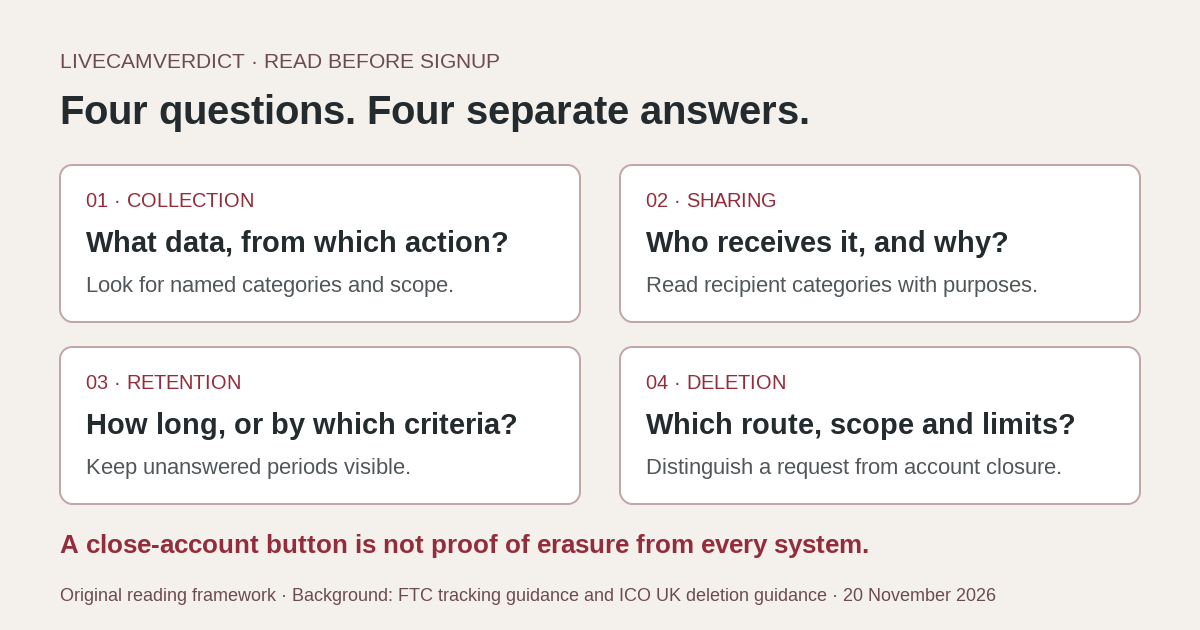
Before registering, find who operates the service, what information it collects, who may receive it, and what the policy says about keeping and deleting it. A cookie choice or account-close button does not answer every one of those questions.
1. Pick one decision before reading
November is a useful time to review what a new account would involve before seasonal offers encourage quick registration. This article does not report a new privacy-policy rollout, a measured trend or an audit of any provider. It offers a repeatable reading method for adults deciding what information they are comfortable sharing.
Begin with the action you are considering: viewing public information, registering, paying or allowing camera access. Those actions raise different questions. Write down the one fact that would change your choice, such as whether the service explains how long a category of account information is retained. Then read for that fact instead of awarding a privacy score from a slogan.
Use the known service address and find its policy from the site footer or official account help. Note the operator named on the policy and its stated scope. A policy for an editorial comparison site does not describe the external provider where you may create an account. Keep those publishers separate in your notes.
2. Map collection to the action you plan
The FTC describes several ways websites and apps collect activity information, including cookies, pixels and device fingerprinting. It also distinguishes first-party from third-party tracking. Those concepts explain why an account form is not a complete inventory of the information a website may process.
Our practical reading method is to make two columns: information you choose to submit, and information the policy says is collected during use. Add only categories the document actually names. If an advertising section mentions another policy, follow that reference before concluding that the main page covers the whole arrangement.
Do not test collection by uploading sensitive information. You can read the explanation without sending identification documents, private conversation screenshots or payment credentials to an editorial contact. Where an intended feature requires additional information, read the provider’s own explanation before choosing whether to proceed.
Reference: FTC: how websites and apps use your information (opens in a new tab)
3. Read sharing and purpose together
Locate the section describing recipients or categories of recipients. Then look for the purpose attached to each category. A statement about a payment processor answers a different question from a statement about advertising partners or account-security providers. The word “partner” alone is a prompt to keep reading, not enough detail to infer every recipient.
Copy a short description into your own notes rather than collecting whole policies. For example, a hypothetical record might say: “The notice identifies a payment-processing purpose; I have not found whether this covers the checkout provider shown to me.” This is an example of a question format, not a finding about a real service.
Look for settings that correspond to your concern, and check the explanation of what a choice changes. A preference control is useful within its documented scope. Do not treat declining one category of cookies as proof that no account, transaction or operational information is retained. If that distinction matters to your decision, ask the service to explain it.
4. Keep retention and account closure separate
Find any stated retention periods or the criteria used to determine them. Ask whether the explanation distinguishes categories, such as profile information, transactions and support requests. If the wording gives only a general purpose, keep the unanswered duration visible in your notes. A missing duration is an uncertainty to clarify, not a license to invent one.
Next find the account-closure route and the separate contact for privacy requests, if one is provided. Record what the document says each route does. A button labeled delete or close is not, by itself, evidence that all information disappears from every system at the same moment.
The UK ICO explains that deletion rights apply in specified circumstances and are not absolute. Its public guidance currently notes that it is under review following legislative changes. That UK guidance is useful background for avoiding an unconditional deletion promise; it does not determine which rules or outcome apply to every reader, country or provider.
Reference: ICO: Your right to get your data deleted (UK guidance; currently under review) (opens in a new tab)
5. Turn unclear wording into a precise question
Use the same four questions on each candidate service. Mark a point “not located” when you have not found an answer, and record the section you checked. That is more useful than silently treating unknown information as a favorable result. The worksheet below describes possible next steps, not actual provider findings.
| Question | Find in the document | If it remains unclear |
|---|---|---|
| What is collected? | Named categories and the actions involved | Which category applies to the feature I plan to use? |
| Who receives it? | Recipient categories and stated purposes | Which policy covers the checkout or linked service? |
| How long is it kept? | Periods or criteria by category | Which retention explanation applies after closure? |
| How can I request deletion? | Official route, scope and stated limitations | How is this different from closing the account? |
6. Make a decision within the evidence
If you need clarification, use the official privacy or support route named by the service. Ask one question and include the relevant section title. You can begin with a general policy question without volunteering private room details. If further verification is required for an account request, follow the official process and first check that you are communicating with the intended operator.
Record the policy address, its displayed revision date if any, and the date you read it. A recent date does not establish that a particular control was tested, and an older date alone does not tell you whether the policy is inaccurate. This worksheet records documentation, not observed backend behavior or a privacy certification.
Finally, compare the unanswered point with your original decision. If it concerns information you are unwilling to provide or a retention condition you cannot accept, pause before registration or payment. You do not need a universal winner to make an informed choice for yourself. Keep your notes minimal and private, and review them if your intended use changes.
Questions & answers
Does this checklist prove that a cam site is private?
No. It helps you read documentation and identify questions. It does not observe backend processing, verify a deletion outcome or certify a provider.
Does closing an account always erase all data?
Do not assume that. Read the service’s current closure, retention and privacy-request explanations and ask how they apply to your circumstances.
Sources & further reading
- FTC: how websites and apps use your information (opens in a new tab)
- ICO: Your right to get your data deleted (UK guidance; currently under review) (opens in a new tab)
References support the specific technical points identified above, not an endorsement of any platform. Consult current documentation for your device and browser.